
Relying solely on traditional web analytics for a Product-Led Growth (PLG) strategy is like navigating a complex maze blindfolded – you might track who enters, but you gain little insight into why they succeed or fail within a given journey. Choosing the wrong analytics platform, or failing to leverage the right one effectively, isn’t just inconvenient; it directly hinders growth potential and leads to wasted investment.
The requirements for digital analytics have shifted. Standard website metrics remain part of the picture, but the critical need now, driven by sophisticated digital products and PLG models, is for deep, granular understanding of the complete customer journey and specific in-product user behaviors.
This brings two powerful platforms into sharp focus: Google Analytics 4 (GA4), the successor standard for many organizations after the transition from Universal Analytics; and Amplitude, a leading platform architected explicitly for deep product and behavioral analytics along with many native data activation modules. While search queries often frame this as Amplitude vs Google Analytics 4, this comparison requires more nuance and depth than either/or.
Viewing these platforms as interchangeable competitors fundamentally misunderstands their distinct design philosophies and core strengths. GA4, deeply integrated within the Google ecosystem, offers robust capabilities for measuring marketing acquisition and overall website engagement. Amplitude was purpose-built to dissect complex user behavior within digital products, providing the granular insights needed for product optimization and for direct data activation (both in-app and on websites) for personalization, experimentation, and for user guides and surveys.
Therefore, the objective isn’t to declare one analytics tool “better.” It is to make an informed strategic choice based on your organization’s specific business model, growth levers, analysis, and data activation needs.
This post dissects the core differences and strategic implications to help determine which analytics platform – or a deliberate combination of GA4 and Amplitude – will best serve your path to growth. In our digital transformation practice, we start the process with the crucial step of business alignment.
So this post should be fuel for exactly such an exercise. It’s not about declaring one platform a winner and one a loser. It’s about taking the time and due diligence to decide which tool(s) are right for you. As many organizations are learning, there are compelling cases for both/and.
Section II: Understanding the Core Philosophies: Marketing Funnel vs. Product Engagement
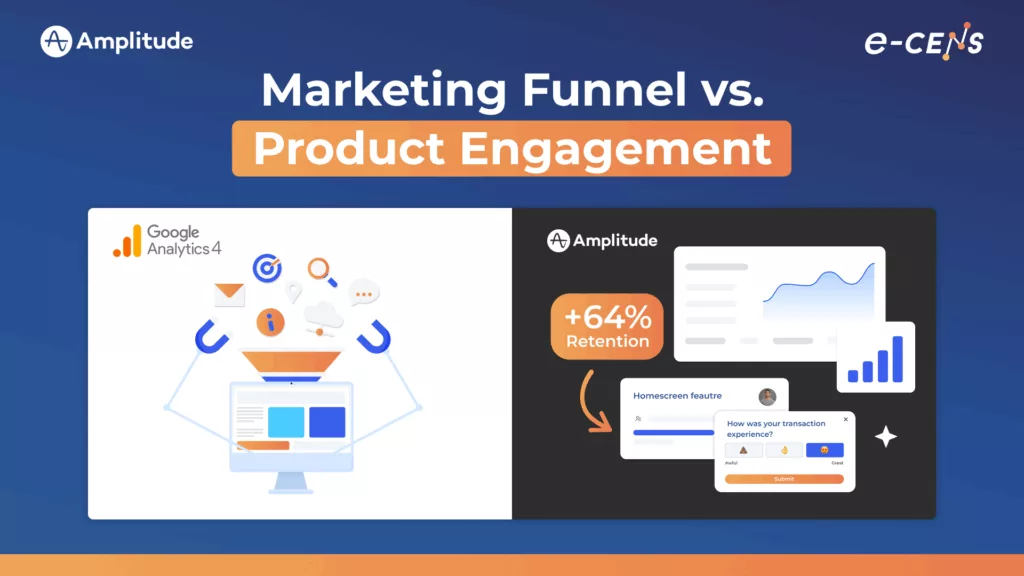
Choosing the right analytics strategy requires understanding the fundamental design philosophy of each platform. GA4 and Amplitude are built to answer different primary business questions, influencing everything from data collection to analysis capabilities.
- Google Analytics 4 (GA4): Optimized for the Acquisition Journey
While GA4 utilizes a flexible event-based model, its core architecture and strengths remain aligned with understanding the journey to and across web properties.
It excels at measuring marketing acquisition channels, attributing website conversions, and providing insights crucial for optimizing ad spend, particularly within the integrated Google Marketing Platform and advertising ecosystem.
It offers a valuable lens on how users arrive and their initial interactions, serving core marketing analytics needs effectively. However, its inherent focus is less on the deep nuances of post-acquisition, in-product behavior.
- Amplitude: Engineered for In-Product Behavioral Analysis
Amplitude Analytics was engineered with a specific focus: enabling teams to gain a deep understanding and act upon user behavior within digital products, such as web applications and mobile apps.
Its architecture revolves around capturing granular event data with rich properties. However, a key differentiator lies in its integrated platform design.
Amplitude excels at facilitating in-UI analysis, allowing teams to directly visualize complex user pathways, build sophisticated behavioral cohorts, define intricate conversion funnels, and generate custom reports without requiring data export.
Crucially, Amplitude provides a seamless workflow connecting these deep analytics insights directly to action. Capabilities such as integrated experimentation, in-app messaging and guides, personalization features, and audience syncing to external platforms are often managed within the same interface.
This tight coupling of analysis and activation empowers teams using Amplitude to move quickly from understanding why users engage, convert, or retain to implementing data-driven optimizations within the product experience itself.
Choosing Amplitude often signifies a strategic commitment to this rapid, integrated cycle of product learning and iteration, fundamentally supporting product-led growth.
- Key Difference: Marketing Effectiveness vs. Product Optimization
This divergence dictates the type of insights each platform readily surfaces. GA4 provides essential data for assessing marketing channel effectiveness and website performance, often presenting data in aggregated views suitable for campaign ROI analysis.
Amplitude delivers the granular, user-level behavioral data required for deep product optimization. It allows teams to move beyond what happened to understand why it happened within the user experience, enabling targeted improvements to features, flows, and overall usability. This depth is crucial for businesses where product engagement directly drives core metrics like retention and lifetime value.
Section III: Strategic Tradeoffs in Core Capabilities
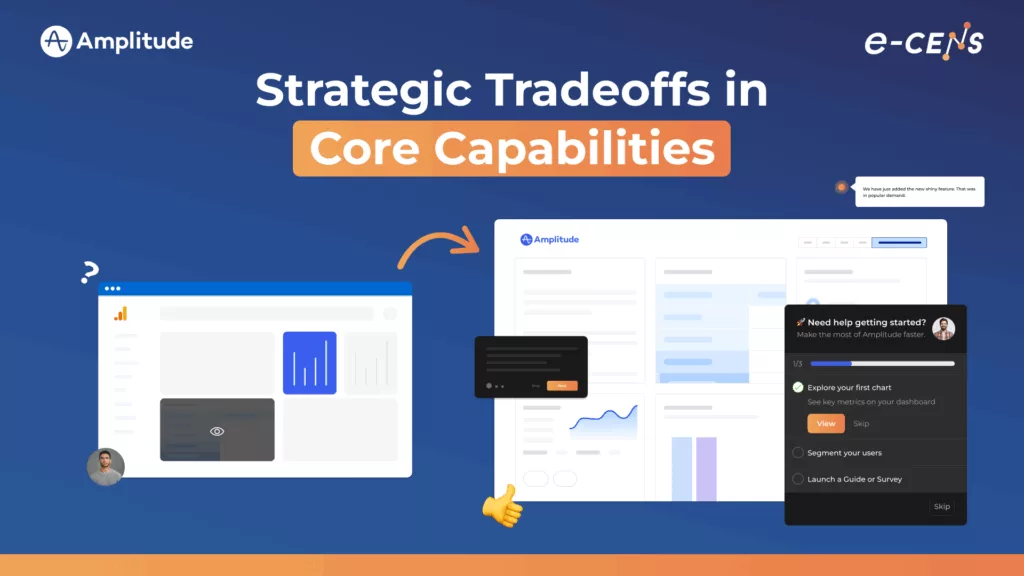
The differing philosophies of Google Analytics 4 and Amplitude manifest in core capabilities, presenting strategic tradeoffs for any organization selecting its analytics foundation. Understanding these tradeoffs and their business consequences is paramount.
Regarding event tracking and data modeling, GA4 employs a flexible event system but often guides users towards predefined structures, with established limits on custom parameters impacting deep customization.
GA4’s event model offers flexibility, analyzing highly specific product interactions with numerous custom properties often requires exporting data to platforms like BigQuery or using connected tools like Looker Studio for the deepest level of granular exploration due to native interface and reporting limitations.
This represents a strategic consideration regarding the resources and workflows needed for complex behavioral analysis.
This approach can suffice for standard website analysis but presents a strategic tradeoff: it potentially limits the richness of behavioral user data captured natively, hindering rapid analysis of nuanced in-product actions.
Amplitude, prioritizing depth, offers extensive flexibility in its event tracking and the ability to define rich, custom taxonomies.
This architecture is explicitly designed to model complex user behaviors directly within the platform, enabling faster insights into feature engagement – a critical need for product-led strategies.
User segmentation highlights another key divergence. GA4 efficiently creates audiences based on demographics and events (i.e. behavioral data), integrating seamlessly with Google Ads and other Google technology for targeted marketing – a significant operational advantage for acquisition teams.
However, this represents a tradeoff against understanding why users behave as they do within the product. Amplitude emphasizes deep behavioral segmentation through dynamic cohorts based on action sequences.
Its detailed user journey analysis tools, like Pathfinder, provide visibility into complex navigation patterns that standard GA4 reports cannot easily replicate. Relying solely on GA4 for product optimization risks missing critical user friction points that Amplitude’s behavioral focus is designed to uncover.
This difference directly impacts a product manager’s ability to diagnose and improve key flows.
The reporting interface and data accessibility further illustrate these strategic choices. GA4 provides valuable standard reports geared towards acquisition, attribution, and website metrics.
Accessing deeper, customized product insights often necessitates analyst resources working with Looker Studio or BigQuery. Furthermore, data consistency gaps between GA4’s UI, Looker Studio, and BigQuery exports are a documented operational challenge requiring rigorous validation, potentially creating reporting bottlenecks and impacting reliable data trust.
This challenge underscores a point we’ve stressed previously on the Digital Disruption podcast: “Robust analytics absolutely depend on getting those foundational elements of data collection and governance right from the start [Spotify | Apple]. Without that underlying trust, data democratization falters.”
Amplitude counters with a self-serve interface centered on product analytics tools and customizable dashboards, empowering product and marketing teams to explore behavioral questions directly.
It provides an environment optimized for rapid iteration on product questions, aiming for internal data consistency. Amplitude also offers extensive API access.
Experimentation capabilities present a clear strategic tradeoff in iteration speed. GA4 necessitates integrating with external A/B testing tools, decoupling the experimentation workflow from the core behavioral data analysis.
This separation can slow down the feedback loop and complicate measuring the true impact of tests on downstream user behavior and product metrics.
Amplitude integrates experimentation directly, allowing tests to be targeted using its rich behavioral user data and results analyzed against core product KPIs within the same platform.
This integrated approach facilitates faster, more data-informed product development cycles, potentially improving time-to-market for critical improvements – a key consideration often highlighted by product analytics consultants.
Even real-time data serves different primary strategic purposes. GA4’s real-time reporting is effective for monitoring immediate website traffic changes or campaign launches.
Amplitude’s real-time streams are more often operationally focused, used by product and engineering teams for instant feedback on feature releases, critical workflow monitoring, and immediate identification of usability issues impacting the user experience.
Section IV: Use Case Scenarios & Strategic Consequences
Applying the differing strengths of GA4 and Amplitude to specific business models clarifies the strategic implications of choosing one over the other, or implementing both. Misalignment between your primary business drivers and your core analytics platform can lead to significant blind spots and missed growth opportunities.
- Scenario 1: Primarily Marketing-Focused (Website is Key Acquisition Channel)
For businesses focused on driving website traffic, optimizing marketing campaigns (especially Google Ads), and tracking standard web conversions, GA4 often provides the necessary capabilities effectively. Its integration with the Google Marketing Platform streamlines workflows for acquisition-focused marketing analytics.- Potential Consequence of Misalignment: Relying solely on GA4 here, without supplementing for deeper behavioral insights if needed later, might mean understanding initial acquisition well but lacking visibility into the long-term value, engagement, and retention patterns of those acquired users. This can lead to optimizing for potentially low-value traffic.
- Scenario 2: Product-Led Growth Business (SaaS, Complex Web App)
In PLG models where the digital product itself drives acquisition, retention, and expansion, Amplitude analytics is typically the more strategically aligned choice. The required focus on feature adoption, detailed funnel optimization within the app, cohort-based retention analysis, and identifying behavioral drivers necessitates Amplitude’s granular product analytics capabilities.- Potential Consequences of Misalignment: Attempting to run a PLG strategy primarily on GA4 risks critical blind spots. Without deep insight into feature engagement, onboarding friction, and nuanced user paths, teams may struggle to identify why users aren’t activating or retaining, directly hindering product iteration cycles and slowing growth. Using Amplitude is often key here.
- Scenario 3: E-commerce Business (Significant Web & Mobile App Presence)
E-commerce frequently requires a nuanced approach, often benefiting significantly from a strategic combination of platforms. The GA4 vs Amplitude for e-commerce discussion often lands here. Use GA4 for its strengths in top-of-funnel marketing attribution and Google Ads synergy. Leverage Amplitude for deep analysis of behavior within the mobile app or complex web checkout flows, optimizing the purchase funnel, measuring feature engagement, and understanding repeat purchase drivers via behavioral metrics.- Potential Consequences of Misalignment: Relying only on GA4 might lead to efficient acquisition but poor understanding of why users abandon carts or fail to make repeat purchases within the app/site experience. Conversely, using only Amplitude might complicate efficient Google Ads optimization. Integrating insights (often via a shared data warehouse) provides the most complete view, mitigating the risks of optimizing only one part of the customer journey.
- Scenario 4: Mobile App-First Business
When a mobile app is the central business and user experience, Amplitude generally provides the necessary depth for product analytics. Analyzing detailed in-app behavior, engagement loops, feature event tracking, and retention metrics is paramount for mobile success.- Potential Consequence of Misalignment: While GA4 (via Firebase) can track installs and basic events, relying solely on it for a mobile-first business means lacking the granular behavioral insights needed to effectively optimize the core app experience, potentially leading to lower engagement, poor retention, and slower user base growth compared to competitors using Amplitude or similar product analytics tools.
Section V: Pricing, Scalability, and Integration: Operational Realities, Strategic Impacts
Beyond core capabilities, the practical aspects of implementing and operating an analytics platform have significant strategic implications.
Cost structures, the ability to handle data growth, and seamless integration within your existing data stack are critical factors when evaluating Amplitude versus Google Analytics 4 (GA4).
Consider the pricing models. GA4 provides a substantial free tier, making Google Analytics accessible for many organizations.
However, exceeding data limits or requiring advanced features necessitates upgrading to the enterprise Analytics 360 version, which involves significant financial commitment and often custom pricing negotiations.
This represents a clear cost threshold that must align with anticipated value.
Amplitude also offers a free starter plan, but quickly moves to usage-based paid tiers, frequently tied to Monthly Tracked Users (MTUs) or event volume. Different feature sets accompany these tiers.
A direct cost comparison of Google Analytics vs Amplitude requires careful modeling based on projected user data volumes and the specific advanced features deemed essential for your workflows, as costs can escalate significantly with usage on either platform’s paid tiers. The key consideration is to design, implement, and utilize your analytics and activation solutions so they become investments rather than cost centers for your organization. This is true whichever technology you invest in.
Scalability is intrinsically linked to pricing and architecture. Both GA4 (particularly Analytics 360) and Amplitude are built on cloud infrastructures designed for large data volumes suitable for successful digital products.
However, organizations must evaluate how each platform’s architecture handles extreme scale and complex querying, and, crucially, how the associated costs scale. Ensure the chosen platform’s scalability aligns financially and technically with your long-term growth projections.
Integration capabilities are paramount for data flow and activating insights across your technology ecosystem.
GA4’s undeniable strength lies in its native integration within the Google ecosystem – Google Ads, DV360, SA360, Looker Studio, and BigQuery. For organizations heavily invested in using Google tools, this simplifies many data analytics, audience sharing, and marketing workflows.
A typical GA4 implementation leverages Google Tag Manager.
Amplitude, conversely, emphasizes broad ecosystem connectivity via its API and numerous dedicated integrations (150+ cited).
This includes seamless links to data warehouses (enabling scenarios like feeding Google Analytics to Amplitude data via warehouse), CDPs, marketing automation, CRMs, and more.
A key strategic differentiator is that Amplitude also allows syncing its detailed behavioral cohorts back to marketing platforms, including Google Ads.
This offers flexibility in applying deep product insights to external campaigns, a potentially critical capability.
Finally, the privacy and compliance infrastructure presents distinct operational and strategic considerations.
Google’s analytics platform is part of its larger advertising business. Amplitude operates solely as an analytics provider (data processor), explicitly supporting GDPR (with an EU data center), signing BAAs for HIPAA, and offering customers fine-grained control over user data.
For businesses needing demonstrably reliable data handling practices or navigating complex regulations, this focused posture and explicit compliance support provide a distinct advantage.
As we covered extensively in our discussions on navigating privacy regulations [Spotify | Apple], understanding how your analytics platform handles data and supports compliance is no longer optional—it’s a core strategic consideration.”
Section VI: Conclusion: Aligning Analytics with Your Growth Strategy
Ultimately, the decision between Google Analytics 4 and Amplitude transcends a simple feature tally.
It’s a fundamental strategic choice about how your organization intends to understand its users and drive growth.
The “best” analytics platform is the one that most effectively empowers your teams—be they marketers or product managers—to achieve your specific business objectives, whether focused on acquisition efficiency or deep product engagement.
To reiterate the core strategic alignment:
| Dimension / Aspect | Google Analytics 4 (GA4) | Amplitude |
| Core Philosophy & Primary Use Case | Engineered to analyze user behavior within digital products, optimizing in-product engagement, retention, and feature adoption for product-led growth for both in-app and website data collection. | Engineered to analyze user behavior within digital products; optimizing in-product engagement, retention, and feature adoption for product-led growth for both in-app and website data collection. |
| Data Granularity & Focus | Often provides broader, aggregated views suitable for marketing channel analysis. Event model allows detail, but deep dives frequently require BigQuery/Looker Studio. | Prioritizes granular, event-stream, and user-level data analysis to understand the ‘why’ behind actions within the product experience. Prioritize complex and granular reporting, visualization, analysis and activation directly from the UI. |
| Key Strengths | Marketing attribution (esp. Google Ads), website traffic analysis, standard conversion tracking, seamless Google Marketing Platform integration. | Prioritizes granular, event-stream, and user-level data analysis to understand the ‘why’ behind actions within the product experience. Prioritize complex and granular reporting, visualization, analysis, and activation directly from the UI. |
| Primary Empowered Users | Marketing teams (especially performance marketing), web analysts focused on acquisition and site-wide metrics. | Deep behavioral analysis (funnels, retention, paths), feature adoption tracking, complex user segmentation (behavioral cohorts), and integrated experimentation. |
| Reporting & Analysis Interface | Product managers, growth teams, UX researchers, and data analysts focused on in-product optimization and user engagement/retention. | Flexible, self-serve interface designed for direct exploration of product/behavioral questions (funnels, retention charts, etc.). Emphasizes data governance. |
| Key Integration Ecosystem | Deep native integration with Google Marketing Platform (Ads, DV360, SA360) and Google Cloud (BigQuery). | Extensive integrations with data warehouses, CDPs, marketing automation/engagement tools; supports data sync back to ad platforms (incl. Google Ads). |
| Experimentation (A/B Testing) | Requires integration with third-party experimentation platforms. | Offers integrated experimentation capabilities linked directly to behavioral data and product KPIs. |
| Voice of Customer (VoC) and UX Interventions | Integrated User Guides & Surveys: deploy surveys directly from the Amplitude UI to behavioral segments. Deploy guides & nudges to assist users at critical journey steps/known friction points. | |
| Privacy & Compliance Posture | Operates within Google’s ads ecosystem; subject to data transfer regulations (e.g., GDPR considerations); typically does not sign BAAs. | Functions solely as an analytics data processor; offers EU data center, signs BAAs, provides explicit features supporting GDPR/CCPA compliance and customer data control. |
For many businesses, particularly those scaling complex digital products alongside robust marketing efforts (like e-commerce or SaaS with both web and mobile app presences), a synergistic approach often yields the most comprehensive insights.
Leveraging GA4 for its acquisition and Google Ads strengths while using Amplitude for deep behavioral and user journey analysis creates a powerful combination. Amplitude also offers the flexibility to push behavioral insights back into marketing channels.
Practical considerations around data trust, integration complexity within your data stack, workflow efficiency, and stringent privacy requirements (where GA4’s approach may differ from Amplitude’s guarantees like BAAs) are also critical factors influencing the right strategic fit. Making this choice requires evaluating not just current needs but also future scalability and compliance demands.
This decision between analytics platforms exemplifies a broader truth about digital maturity: Success isn’t just about having data; it’s about embedding the right analytical capabilities and data culture to consistently translate insights into impactful business actions.
Navigating these tradeoffs effectively, ensuring chosen platforms are implemented correctly, and fostering the skills to leverage them often requires expert guidance tailored to your specific context.
Need Help Navigating Your Analytics Strategy?
Making the right choice for your analytics stack is a critical decision with long-term implications.
Understanding the nuances between platforms like Google Analytics 4 and Amplitude, assessing your specific needs against their capabilities, and planning a successful implementation requires careful consideration and deep expertise.
As official partners with both Amplitude and Google (including GMP certification), e-CENS is uniquely positioned to provide objective, expert guidance. We help organizations navigate this process, from current state assessments and strategic roadmap development to platform implementation and team enablement. We ensure you choose and leverage the analytics foundation that truly drives business growth.
Get in touch with us today to discuss how we can help you make the most informed analytics decisions for your future.