
- Retention Importance: Retaining customers is vital for long-term success, with a small increase in retention potentially boosting profits significantly.
- Data-Driven Marketing: Leveraging customer data enables personalized experiences that resonate with individual customers.
- Data Collection: Gather data from multiple sources (web analytics, CRM, social media) and ensure its accuracy through validation and regular audits.
- Customer Segmentation: Segment customers based on demographics and behaviors to tailor retention strategies and build comprehensive profiles.
- Predictive Analytics: Use predictive analytics to identify churn risks and proactively address potential losses, regularly updating models with new data.
- Personalization: Personalize marketing messages and offers based on customer segments across all channels.
- Loyalty Programs: Design effective loyalty programs with tiered rewards and gamification to incentivize repeat purchases.
- Encourage Advocacy: Turn loyal customers into advocates through referral programs and recognition of their efforts.
- Continuous Improvement: Collect and analyze feedback to identify pain points and refine retention strategies regularly.
- Customer Delight: Focus on exceeding expectations to create emotional connections that foster loyalty.
Keeping customers coming back can be challenging in today’s world, where options are just a click away.
With so many choices out there, how do you make sure your customers stick around? The secret might lie in the data you already have!
Picture this: what if you could turn every interaction into a personalized experience that makes your customers feel valued and understood?
Sounds pretty great, right? In this blog, we’ll explore how tapping into data-driven marketing can help you boost customer retention and turn casual shoppers into loyal fans.
Let’s jump in and discover some simple yet effective strategies to keep your customers coming back for more!
I. Understanding the Power of Data
Customer retention has become a critical factor for long-term success.
As acquisition costs continue to rise, keeping existing customers loyal and engaged is more important than ever.
This is where data-driven marketing comes into play as a powerful tool for enhancing customer retention.
Data-driven strategies allow businesses to move beyond gut instinct and guesswork, instead leveraging concrete insights to inform decision-making and optimize the customer experience.
By harnessing the wealth of data available on customer behaviors, preferences, and interactions, companies can craft highly targeted retention campaigns that resonate on a personal level.
Some key benefits of leveraging customer data for retention include:
- Personalization at scale: Data allows for customized messaging, offers, and experiences tailored to individual customers.
- Predictive capabilities: Advanced analytics can forecast churn risk and customer lifetime value.
- Improved customer understanding: Data provides a 360-degree view of each customer’s journey and pain points.
- Optimized timing and channels: Analytics reveal when and how customers prefer to engage.
- Measurement of retention efforts: Data enables tracking of key metrics to gauge campaign effectiveness.
To unlock these benefits, businesses should focus on collecting and analyzing several key types of customer data:
- Demographic data: Age, gender, location, income level, etc.
- Behavioral data: Purchase history, website interactions, email engagement, etc.
- Psychographic data: Interests, values, lifestyle factors, etc.
- Feedback and sentiment data: Survey responses, reviews, social media comments, etc.
- Customer service data: Support tickets, call logs, chat transcripts, etc.
By combining these diverse data points, companies can build comprehensive customer profiles and segments to power their retention strategies. The key is moving beyond surface-level information to truly understand the motivations and needs driving customer behavior.
For example, rather than simply knowing a customer’s purchase history, data can reveal their browsing patterns leading up to a sale, preferred communication channels, pain points experienced, and likelihood to churn. This nuanced understanding allows for much more targeted and effective retention campaigns.
It’s also important to note that data-driven retention is an ongoing process, not a one-time effort. Customer needs and behaviors evolve over time, so retention strategies must continuously adapt based on the latest insights. Regular analysis of retention metrics and campaign performance is crucial for optimization.
When implemented effectively, data-driven retention marketing can yield significant ROI. Studies have shown that increasing customer retention rates by just 5% can boost profits by 25-95%. The cost of retaining an existing customer is also 5-25 times less than acquiring a new one.
However, simply having data isn’t enough – it’s how you leverage it that matters. In the following sections, we’ll explore concrete strategies for collecting, analyzing, and activating customer data to drive retention and loyalty. By embracing a data-driven approach, businesses can move beyond reactive retention efforts to proactively delight customers at every stage of their journey.
II. Data Collection and Consolidation
Effective data-driven retention marketing starts with having the right data at your fingertips. This requires a strategic approach to data collection and consolidation across multiple touchpoints and systems. Here are some key considerations for building a robust customer data foundation:
Sources of Customer Data
To gain a holistic view of your customers, it’s important to tap into diverse data sources:
- Website analytics: Tools like Google Analytics provide rich data on site visitor behavior, including pages viewed, time on site, conversion paths, etc.
- CRM systems: Your CRM houses valuable data on customer interactions, purchase history, support tickets, and more.
- Marketing automation platforms: These capture data on email engagement, campaign performance, lead scoring, etc.
- Social media: Social listening tools can track mentions, sentiment, and engagement across social channels.
- Surveys and feedback: Direct customer input via surveys, reviews, and feedback forms.
- Point-of-sale systems: Transactional data from in-store or online purchases.
- Mobile apps: In-app behavior and usage data.
- Customer support channels: Chat logs, call transcripts, and ticket data.
- Third-party data providers: Additional demographic, firmographic, or behavioral data to enrich customer profiles.
The key is identifying which data sources are most relevant to your specific retention goals and customer base. Focus on quality over quantity – having too much disorganized data can be counterproductive.
Ensuring Data Accuracy and Fidelity
Once you’ve identified your key data sources, it’s crucial to ensure the data collected is accurate and reliable. Some best practices include:
- Implement data validation rules to catch errors at the point of entry
- Regularly audit and clean your data to remove duplicates, correct inaccuracies, etc.
- Use data normalization techniques to ensure consistency across sources
- Implement data governance policies to maintain quality standards
- Leverage data verification services to validate contact information
- Train staff on proper data entry procedures
Remember, your retention efforts are only as good as the data fueling them. Bad data leads to misguided strategies and wasted resources.
Integrating Data from Multiple Channels
With data flowing in from various sources, the next challenge is integrating it into a unified customer view. This is where a customer data platform (CDP) or data warehouse comes into play. These systems act as a central repository, consolidating data from disparate sources and creating a single source of truth.
Key steps for effective data integration include:
- Map out your data ecosystem: Identify all data sources and how they interconnect.
- Standardize data formats: Ensure consistency in how data is structured and labeled across systems.
- Implement unique customer identifiers: Use consistent IDs to link data to individual customers across touchpoints.
- Set up automated data flows: Create processes to regularly sync data from source systems to your central platform.
- Resolve identity: Use identity resolution techniques to match data from different sources to the same customer.
- Create a unified customer profile: Combine all data points into a comprehensive view of each customer.
By breaking down data silos and creating a single customer view, you’ll be better equipped to deliver personalized retention strategies.
Data Cleansing and Organization
Even with solid collection and integration processes, regular data maintenance is essential. This involves:
- Deduplication: Identifying and merging duplicate customer records.
- Data enrichment: Filling in missing information from third-party sources.
- Data standardization: Ensuring consistent formatting (e.g. phone numbers, addresses).
- Data archiving: Moving old or irrelevant data to archive storage.
- Data classification: Tagging and categorizing data for easier analysis.
- Access controls: Implementing proper security measures to protect sensitive data.
Well-organized, high-quality data is the foundation for all your retention efforts. Invest the time upfront to get your data house in order, and you’ll reap the rewards in more effective, targeted retention campaigns.
By following these data collection and consolidation best practices, you’ll be well-positioned to leverage customer insights for improved retention. In the next section, we’ll explore how to segment and profile your customer base using this rich data foundation.
III. Customer Segmentation and Profiling
Once you have a solid foundation of consolidated customer data, the next step is to segment your customer base and build comprehensive profiles. This allows you to move beyond one-size-fits-all retention strategies and deliver truly personalized experiences.
Segmenting Customers Based on Characteristics
Customer segmentation involves dividing your audience into distinct groups based on shared characteristics. This allows for more targeted marketing efforts and personalized retention strategies. Some key segmentation criteria include:
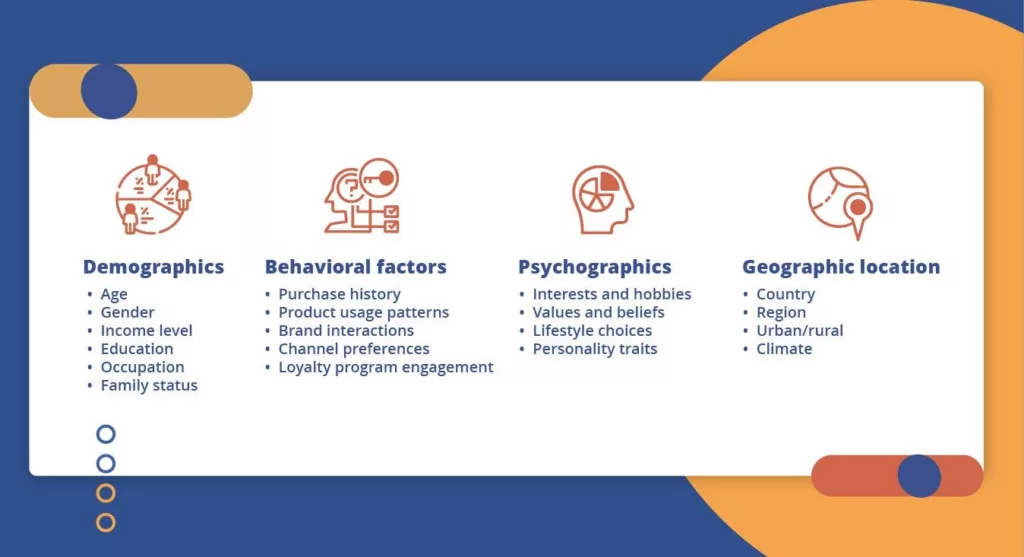
The specific segmentation criteria you use will depend on your business model and customer base. The key is identifying the factors most relevant to your retention goals.
For example, an e-commerce company might segment customers based on:
- Purchase frequency (one-time vs. repeat buyers)
- Average order value (high vs. low spenders)
- Product category preferences
- Recency of last purchase
This segmentation would allow for targeted campaigns to re-engage lapsed customers, upsell high-value products to big spenders, or cross-sell complementary items based on past purchases.
Building Comprehensive Customer Profiles
While segmentation groups customers with shared traits, customer profiling dives deeper to create detailed portraits of individual customers or buyer personas.
A comprehensive customer profile typically includes:
- Demographic information
- Purchase history and preferences
- Interaction history across channels
- Product usage data
- Customer service interactions
- Loyalty program status
- Psychographic insights
- Predictive metrics (e.g. churn risk, lifetime value)
The goal is to build a 360-degree view of each customer that informs personalized retention efforts. Modern customer data platforms (CDPs) can automate much of this profile building by aggregating data from multiple sources.
Identifying High-Value and At-Risk Customers
With robust customer profiles in place, you can more easily identify your most valuable customers as well as those at risk of churning. This allows you to prioritize your retention efforts for maximum impact.
Identifying high-value customers:
- Look at metrics like total revenue, purchase frequency, and average order value
- Consider customer lifetime value (CLV) predictions
- Factor in non-monetary value like referrals or social influence
- Analyze engagement levels across channels
Spotting at-risk customers:
- Monitor for decreases in purchase frequency or engagement
- Look for patterns in product returns or negative feedback
- Analyze support ticket volume and sentiment
- Use predictive churn models to forecast risk
Once identified, you can craft tailored retention strategies for each group. For high-value customers, this might involve exclusive perks or early access to new products. For at-risk customers, proactive outreach and win-back campaigns may be appropriate.
Utilizing Segmentation for Targeted Retention Efforts
The true power of customer segmentation and profiling comes from activating these insights in your retention marketing. Some ways to leverage segmentation include:
- Personalized email campaigns: Tailor content, offers, and send times based on segment preferences.
- Targeted ads: Create custom audiences for retargeting campaigns on social media and display networks.
- Product recommendations: Suggest relevant items based on segment purchase history and browsing behavior.
- Loyalty program tiers: Offer differentiated rewards and perks for high-value customer segments.
- Customized content: Deliver relevant blog posts, videos, and resources to each segment.
- Personalized customer service: Equip support teams with segment data to provide contextualized assistance.
The key is moving beyond broad, one-size-fits-all retention tactics to deliver experiences that resonate with each customer segment. This level of personalization is proven to boost engagement, satisfaction, and ultimately, retention rates.
By continually refining your segmentation and profiling based on new data insights, you can create an evolving retention strategy that adapts to changing customer needs and behaviors. In the next section, we’ll explore how to leverage predictive analytics to take your retention efforts to the next level.
IV. Predictive Analytics for Customer Retention
Predictive analytics takes data-driven retention to the next level by forecasting future customer behavior and identifying opportunities for intervention. By leveraging machine learning and advanced statistical models, businesses can move from reactive to proactive retention strategies.
Leveraging Machine Learning and Predictive Models
At its core, predictive analytics uses historical data to identify patterns and forecast future outcomes. In the context of customer retention, this typically involves:
- Data preparation: Cleaning and formatting historical customer data for analysis.
- Feature selection: Identifying the most relevant variables that influence retention.
- Model training: Using machine learning algorithms to detect patterns in the data.
- Model validation: Testing the model’s accuracy on a holdout dataset.
- Deployment: Integrating the model into business processes for real-time predictions.
Some common machine learning techniques used in retention prediction include:
- Logistic regression: Predicts the probability of churn based on various factors.
- Decision trees: Create rule-based models for classifying customers as likely to churn or retain.
- Random forests: Combine multiple decision trees for improved accuracy.
- Gradient boosting: Builds a series of weak models that are combined into a strong predictor.
- Neural networks: Can capture complex, non-linear relationships in customer data.
The choice of model depends on your specific use case and data characteristics. Many businesses use ensemble methods that combine multiple models for optimal performance.
Identifying Churn Risks and Potential Customer Losses
One of the primary applications of predictive analytics in retention is churn prediction. By analyzing historical data on customers who have churned in the past, models can identify similar patterns in current customers to forecast churn risk.
Key variables that often factor into churn prediction models include:
- Recent purchase activity
- Changes in engagement levels (e.g. email opens, site visits)
- Customer service interactions
- Product usage data
- Contract renewal dates
- Competitive offerings in the market
The output is typically a churn risk score for each customer, allowing businesses to prioritize retention efforts on those most likely to leave.
It’s important to note that churn prediction should be an ongoing process, not a one-time effort. Models should be regularly retrained on new data to maintain accuracy as customer behaviors evolve.
Proactive Retention Strategies Based on Predictions
Once you’ve identified customers at risk of churning, the next step is taking proactive action to retain them.
Some strategies include:
- Personalized outreach: Reach out to high-risk customers with tailored offers or support.
- Win-back campaigns: Target recently churned customers with incentives to return.
- Loyalty program adjustments: Offer enhanced perks to valuable customers showing signs of disengagement.
- Product education: Provide additional training or resources to boost engagement for at-risk users.
- Preemptive problem-solving: Address potential issues before they lead to churn.
- Customized renewal offers: Tailor contract renewal terms based on predicted churn risk.
The key is intervening early, before the customer has made the decision to leave. Predictive models allow you to get ahead of potential churn rather than reacting after the fact.
Optimizing Customer Experiences Through Data-Driven Insights
Beyond churn prediction, predictive analytics can optimize the overall customer experience to drive long-term retention.
Some applications include:
- Next best action: Recommending the optimal next step in the customer journey.
- Lifetime value prediction: Forecasting a customer’s long-term value to inform investment decisions.
- Product recommendation engines: Suggesting relevant items based on predicted preferences.
- Dynamic pricing: Adjusting prices based on predicted willingness to pay.
- Customer service routing: Directing queries to the best-suited agent based on predicted needs.
- Marketing campaign optimization: Predicting the most effective channels and messaging for each customer.
By leveraging predictive insights across touchpoints, businesses can create more seamless, personalized experiences that keep customers engaged and loyal.
Implementing predictive analytics for retention requires investment in data infrastructure, analytical talent, and often specialized software.
However, the returns can be significant. Studies have shown that predictive retention strategies can reduce churn by 10-30% and increase customer lifetime value by up to 50%.
As with all data-driven efforts, it’s crucial to continually test and refine your predictive models. Customer behaviors change over time, so your analytics approach must evolve as well.
In the next section, we’ll explore how to translate these predictive insights into highly personalized retention campaigns.
V. Personalization and Targeted Campaigns
With robust customer data and predictive insights in hand, the next step is translating this knowledge into highly personalized retention campaigns. Personalization has become a key differentiator in today’s market, with 80% of consumers more likely to purchase from brands that provide personalized experiences.
Tailoring Marketing Messages and Offers Based on Customer Segments
The foundation of personalized retention marketing is delivering the right message to the right customer at the right time.
This starts with leveraging your customer segmentation to craft tailored campaigns for each group.
Some strategies for segment-based personalization include:
- Customized email content: Vary subject lines, body copy, and calls-to-action based on segment preferences and behaviors.
- Targeted promotions: Offer discounts or deals aligned with each segment’s purchase history and price sensitivity.
- Product recommendations: Showcase items likely to appeal to specific segments based on past purchases and browsing behavior.
- Loyalty program tiers: Create differentiated reward structures for high-value vs. casual customers.
- Personalized landing pages: Dynamically adjust website content to highlight relevant products and offers for each segment.
The key is moving beyond basic personalization like using a customer’s name, to delivering truly relevant content and offers based on deep customer understanding.
Utilizing Personalization in Email Campaigns, Social Media, and Website Experiences
Effective personalization should be consistent across all customer touchpoints. Here’s how to approach it on key channels:
Email Campaigns:
- Use dynamic content blocks to customize email body based on recipient attributes
- Personalize send times based on each subscriber’s engagement patterns
- Trigger automated emails based on specific customer actions or milestones
- Segment email lists for more targeted messaging
Social Media:
- Create custom audiences on platforms like Facebook and LinkedIn based on your customer segments
- Tailor ad creative and copy to resonate with each audience
- Use retargeting to re-engage website visitors with personalized offers
- Leverage social listening to engage customers with relevant, timely content
Website Experiences:
- Implement dynamic content to show personalized product recommendations
- Use geolocation to display region-specific offers and information
- Customize navigation and site layout based on visitor behavior and preferences
- Personalize exit-intent popups with targeted offers to reduce bounce rates
The goal is to create a cohesive, personalized experience as customers move between channels. This not only improves the customer experience but also reinforces your retention messaging across touchpoints.
Delivering Relevant Content and Recommendations
Content plays a crucial role in retention marketing, helping to educate, engage, and add value for customers beyond your core product or service. Personalized content recommendations can significantly boost engagement and loyalty.
Some strategies for delivering relevant content include:
- Behavioral targeting: Recommend articles or resources based on a customer’s browsing history and interests.
- Lifecycle stage content: Provide educational content tailored to where a customer is in their journey with your brand.
- Persona-based content: Create content themes and topics aligned with your key customer personas.
- User-generated content: Showcase reviews, testimonials, or social posts from similar customers.
- Interactive content: Offer personalized quizzes, assessments, or calculators that provide value to the customer.
The key is using your customer data to understand what type of content will resonate most with each individual or segment, then delivering it at the right moment in their journey.
A/B Testing and Continuous Optimization
Personalization is not a “set it and forget it” tactic. It requires ongoing testing and refinement to maximize effectiveness. A/B testing allows you to compare different personalization strategies and identify what resonates most with your audience.
Some elements to consider A/B testing include:
- Email subject lines and preview text
- Call-to-action button copy and design
- Product recommendation algorithms
- Website layout and navigation
- Ad creative and copy
- Offer types and discount levels
Start with testing broad concepts, then drill down into more granular elements as you identify winning strategies. Use your customer segmentation to run targeted tests for different audience groups.
It’s also important to regularly review your personalization rules and algorithms to ensure they’re still relevant. Customer preferences and behaviors change over time, so your approach must evolve as well.
By continually refining your personalization strategy based on performance data, you can create ever-more-relevant experiences that drive long-term customer retention.
Remember, the goal of personalization is not just to boost short-term metrics, but to build deeper, more meaningful relationships with your customers.
In the next section, we’ll explore how to leverage these personalized experiences into formal customer engagement and loyalty programs.
VI. Customer Engagement and Loyalty Programs
While personalized marketing can significantly boost retention, formalizing your efforts through structured engagement and loyalty programs can take customer retention to the next level. These programs provide a framework for consistently rewarding and recognizing your most valuable customers.
Designing Effective Loyalty Programs to Incentivize Retention
A well-designed loyalty program can be a powerful tool for driving repeat purchases and long-term customer value. Key elements to consider when designing your program include:
- Clear value proposition: Clearly communicate the benefits of participation to encourage sign-ups.
- Tiered rewards: Create multiple membership levels to motivate customers to increase engagement.
- Diverse reward options: Offer a mix of transactional discounts, exclusive perks, and experiential rewards.
- Easy point accumulation: Make it simple for customers to earn points across channels and interactions.
- Attainable rewards: Ensure rewards feel achievable to maintain motivation.
- Personalized offers: Tailor rewards and promotions to individual member preferences.
- Emotional connection: Go beyond transactional benefits to forge a deeper brand connection.
- Omnichannel integration: Allow members to earn and redeem across all touchpoints.
- Mobile optimization: Create a seamless mobile experience for on-the-go engagement.
- Regular communication: Keep members informed of their status, available rewards, and program updates.
The specific structure of your loyalty program will depend on your business model and customer base. For example, a coffee shop might offer a simple “buy 10, get 1 free” punch card, while a luxury retailer might create an invitation-only tiered program with exclusive events and personalized services.
Leveraging Gamification and Rewards
Gamification elements can add an element of fun and competition to your loyalty program, boosting engagement. Some gamification tactics to consider:
- Progress bars: Visualize a member’s progress towards the next reward or tier.
- Challenges and badges: Create short-term goals with special badges or bonuses upon completion.
- Leaderboards: Foster friendly competition by showcasing top point earners.
- Surprise and delight: Randomly reward members with unexpected bonuses.
- Limited-time offers: Create a sense of urgency with time-sensitive promotions.
- Social sharing: Encourage members to share achievements for bonus points.
The key is finding the right balance of game-like elements that motivate without feeling gimmicky or overly complex.
Encouraging Customer Advocacy and Referrals
Turning loyal customers into brand advocates can significantly amplify your retention efforts. Satisfied customers who refer others tend to have higher lifetime value themselves, while their referrals often become high-value customers as well.
Some strategies to encourage advocacy and referrals include:
- Referral bonuses: Offer rewards for successful referrals, to both the referrer and the new customer.
- User-generated content campaigns: Encourage customers to share photos or stories featuring your products.
- Exclusive “insider” groups: Create VIP communities for your most loyal customers to share feedback and access early product releases.
- Ambassador programs: Formalize relationships with your biggest fans, providing them with special perks in exchange for promoting your brand.
- Review incentives: Offer small rewards for leaving honest product reviews.
- Social media spotlights: Regularly feature customer stories and testimonials on your social channels.
Remember, the goal is to make advocacy feel natural and rewarding, not forced or transactional.
Measuring and Improving Customer Lifetime Value (CLV)
Customer Lifetime Value (CLV) is a crucial metric for assessing the long-term impact of your retention efforts. It represents the total revenue a customer is expected to generate over their entire relationship with your business.
To calculate basic CLV:
- Determine average purchase value
- Multiply by average purchase frequency
- Multiply by average customer lifespan
For more accuracy, factor in costs and use discounted cash flow analysis to account for the time value of money.
Strategies to improve CLV through your loyalty program include:
- Increase purchase frequency: Use targeted promotions and reminders to encourage more regular engagement.
- Boost average order value: Offer tiered rewards or bonuses for larger purchases.
- Extend customer lifespan: Provide long-term incentives and create emotional connections to reduce churn.
- Cross-sell and upsell: Use program data to recommend relevant additional products.
- Reduce acquisition costs: Leverage member referrals to acquire new customers more efficiently.
Regularly analyze your CLV data to identify opportunities for improvement and to measure the ROI of your retention initiatives.
By creating a well-structured loyalty program that goes beyond simple transactional rewards, you can create deeper emotional connections with customers that drive long-term retention and advocacy.
In the final section, we’ll explore how to use customer feedback to refine and improve your retention strategies continuously.
VII. Data-Driven Feedback and Continuous Improvement
The most effective customer retention strategies are those that continuously evolve based on customer feedback and performance data. By creating a closed feedback loop, businesses can identify pain points, uncover new opportunities, and stay aligned with changing customer needs.
Collecting and Analyzing Customer Feedback
Customer feedback comes in many forms, both solicited and unsolicited. Key sources to monitor include:
- Surveys: Post-purchase, NPS, CSAT, and other structured feedback collection.
- Reviews: Product and service reviews on your website or third-party platforms.
- Social media: Comments, mentions, and direct messages across social channels.
- Customer support interactions: Tickets, chat logs, and call transcripts.
- Sales and account management conversations: Insights gathered during customer meetings.
- Website behavior: Analysis of how customers interact with your site, including heatmaps and session recordings.
- In-app feedback: User behavior and direct feedback within mobile or web applications.
To make sense of this diverse feedback, consider using text analytics and sentiment analysis tools. These can help categorize feedback themes and gauge overall customer sentiment at scale.
It’s also important to close the feedback loop by acknowledging and responding to customer input, especially for direct communications like surveys or social media comments.
Identifying Pain Points and Areas for Improvement
Once you’ve collected customer feedback, the next step is translating it into actionable insights. Look for patterns and trends that highlight:
- Common customer complaints or frustrations
- Features or services customers are requesting
- Points of friction in the customer journey
- Reasons for customer churn
- Positive experiences that drive loyalty
Prioritize issues based on their impact on customer retention and overall business goals. Create cross-functional teams to address systemic issues that span multiple departments.
Some techniques for uncovering insights include:
- Journey mapping: Visualize the end-to-end customer experience to identify pain points.
- Root cause analysis: Dig deeper into issues to address underlying causes, not just symptoms.
- Cohort analysis: Compare retention rates and feedback across different customer segments.
- Competitive benchmarking: Understand how your retention efforts stack up against
industry peers.
Remember to look beyond just negative feedback. Understanding what drives positive experiences can be just as valuable for improving retention.
Continuously Refining Retention Strategies Based on Data Insights
Customer retention is an ongoing process, not a one-time initiative. Use the insights gathered from feedback and performance data to continuously refine your approach:
- Set clear retention goals: Define KPIs like churn rate, customer lifetime value, and NPS scores.
- Establish a testing framework: Implement A/B testing for key retention initiatives to measure impact.
- Create cross-functional retention teams: Bring together members from marketing, product, support, and other relevant departments.
- Develop an insights distribution system: Ensure customer feedback reaches the right teams for action.
- Implement regular review cycles: Schedule recurring meetings to assess retention performance and adjust strategies.
- Invest in retention-focused technology: Leverage CRM, marketing automation, and analytics tools to streamline retention efforts.
- Train employees on retention best practices: Ensure all customer-facing staff understand their role in driving loyalty.
- Celebrate retention wins: Recognize and reward employees for successfully retaining at-risk customers.
The key is creating a culture of continuous improvement, where customer feedback is valued and actively incorporated into business processes.
Adapting to Changing Customer Needs and Market Trends
Customer needs and expectations are constantly evolving, influenced by technological advances, cultural shifts, and competitive offerings. To maintain strong retention rates, businesses must stay attuned to these changes and adapt accordingly.
Some strategies for staying ahead of the curve:
- Trend monitoring: Regularly review industry publications, attend conferences, and engage with thought leaders to spot emerging trends.
- Customer advisory boards: Create a formal group of key customers to provide ongoing feedback and insights.
- Predictive analytics: Use advanced modeling to forecast changing customer needs based on early indicators.
- Agile development processes: Implement flexible product development methods to quickly respond to customer feedback.
- Continuous competitive analysis: Regularly assess competitor offerings and retention strategies.
- Scenario planning: Develop contingency plans for potential market disruptions or shifts in customer behavior.
By proactively adapting to changing needs, you can ensure your retention strategies remain relevant and effective over time.
Remember, the goal of all these efforts is to create a customer-centric organization that consistently delivers value and earns long-term loyalty. By embedding data-driven feedback processes throughout your business, you can create a virtuous cycle of continuous improvement that drives ever-stronger customer retention.
Fostering Customer Delight: The Key to Lasting Loyalty
As we’ve explored throughout this article, enhancing customer retention through data-driven marketing is a multifaceted endeavor.
From building a solid data foundation to implementing predictive analytics, personalizing experiences, and continuously refining strategies based on feedback, there are numerous levers businesses can pull to boost loyalty.
However, it’s crucial to remember that at the heart of all these efforts is a simple goal: delighting your customers. While data and technology provide powerful tools for understanding and engaging customers, true loyalty stems from consistently exceeding expectations and creating emotional connections.
As you implement the strategies we’ve discussed, always keep the customer experience at the forefront. Use data to anticipate needs, solve problems proactively, and deliver pleasant surprises.
Empower your employees with customer insights so they can provide more empathetic, personalized service. And most importantly, listen to your customers and show them that their feedback drives meaningful change.
By combining data-driven insights with a genuine commitment to customer satisfaction, you can create a retention strategy that not only reduces churn but fosters true brand advocates. In today’s competitive landscape, this level of customer loyalty can be your most powerful differentiator and growth driver.
Remember, customer retention is not a destination, but an ongoing journey of understanding, adapting, and delighting. Embrace the process, stay curious about your customers, and never stop looking for ways to add value to their lives. With this approach, you’ll be well-positioned to build lasting customer relationships that drive sustainable business success.