
What Is Server-Side Tracking, and How Does It Differ From Client-Side Tracking?
Server-side tracking represents a paradigm shift in how businesses collect, process, and transmit data for analytics and marketing purposes.
Unlike traditional client-side tracking, which relies on JavaScript code running in a user’s browser to capture and send data, server-side tracking moves much of this process to a secure server environment under the organization’s control.
Understanding the Basics of Server-Side Tracking
At its core, server-side tracking involves sending data from a website or application to a dedicated server before it reaches its final destination (like Google Analytics or Facebook). This intermediate server acts as a data processing hub, allowing businesses to have greater control over the information flow.
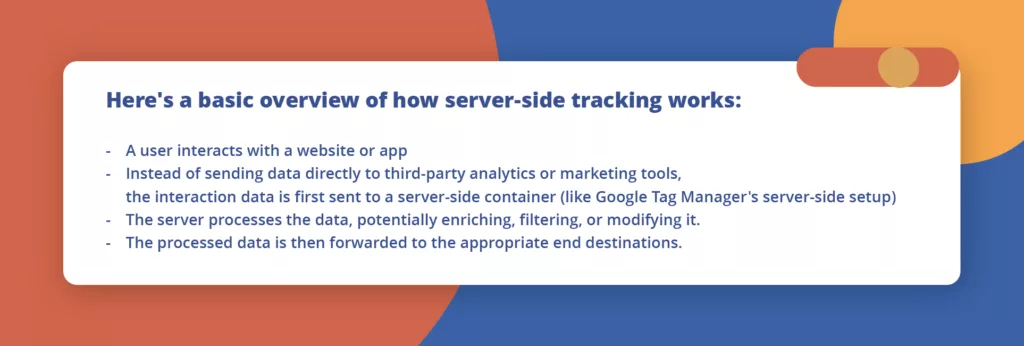
This approach offers several advantages, which we’ll explore in more depth throughout this article.
Key Differences Between Server-Side and Client-Side Tracking
To fully appreciate the benefits of server-side tracking, it’s essential to understand how it differs from the more common client-side approach:
- Data collection:
- Client-side: Relies on JavaScript running in the user’s browser to collect and send data
- Server-side: Data collection can still involve some client-side code, but the heavy lifting happens on a controlled server
- Processing power:
- Client-side: Limited by the user’s device capabilities
- Server-side: Can leverage more powerful server resources for complex data processing
- Control and flexibility:
- Client-side: Limited control once the tracking code is on the user’s device
- Server-side: Offers much greater control over data flow and processing
- Privacy and security:
- Client-side: More vulnerable to ad blockers and potential security risks
- Server-side: Provides enhanced privacy controls and can bypass many ad blockers
- Performance impact:
- Client-side: Can potentially slow down page load times
- Server-side: Reduces the JavaScript burden on the client, potentially improving site performance
The Role of Server-Side Tagging in Modern Analytics
Server-side tagging, particularly through platforms like Google Tag Manager’s server-side offering, is becoming increasingly crucial in the modern analytics landscape.
Here’s why:
- Data accuracy: As privacy regulations tighten and browsers implement stricter tracking prevention measures, server-side tagging helps ensure more consistent and accurate data collection.
- Flexibility: Server-side setups allow for more complex data transformations and integrations between different tools and platforms.
- Future-proofing: As the digital landscape evolves, server-side tracking provides a more adaptable foundation for implementing new technologies and complying with changing regulations.
- Performance optimization: By reducing the amount of JavaScript that needs to run in the browser, server-side tagging can contribute to faster page load times and improved user experience.
- Enhanced security: Sensitive operations like API calls with secret keys can be handled server-side, reducing exposure of this information to potential bad actors.
As we move forward, understanding and implementing server-side tracking will become an essential skill for digital marketers, analysts, and developers looking to build robust, privacy-conscious, and high-performance tracking solutions.
Why Is Server-Side Tracking Becoming Increasingly Important?

The digital landscape is rapidly evolving, with new privacy regulations, changing consumer expectations, and technological advancements reshaping how businesses collect and utilize data. In this context, server-side tracking is emerging as a critical solution to address many of the challenges faced by traditional client-side tracking methods.
Anti-tracking and ad-blocking challenges
One of the primary drivers behind the growing importance of server-side tracking is the increasing prevalence of tracking prevention technologies and ad blockers.
These tools, while designed to protect user privacy, can significantly impact the accuracy and completeness of data collected through client-side methods.
Impact of tracking prevention:
- Intelligent Tracking Prevention (ITP) in Safari and similar technologies in other browsers limit the lifespan of cookies and restrict cross-site tracking capabilities.
- This can lead to inflated user counts and difficulties in accurately attributing conversions across longer customer journeys.
Ad blocker challenges:
- Ad-blocking software can prevent analytics scripts from loading, resulting in missed data collection opportunities.
- Even when analytics scripts do load, ad blockers may interfere with the transmission of data to third-party endpoints.
Server-side tracking helps address these issues by:
- Moving data collection to a first-party context, making it less likely to be blocked or restricted
- Allowing for more durable cookie solutions that are set server-side
- Providing greater control over how and when data is sent to third-party vendors
Enhancing data quality and accuracy with server-side tracking
Beyond overcoming technical barriers, server-side tracking offers significant advantages in terms of data quality and accuracy:
Consistent data collection:
- Server-side tracking is less susceptible to variations in browser implementations or user settings, leading to more consistent data collection across different platforms and devices.
Data enrichment:
- With server-side processing, businesses can enrich event data with additional information from databases or APIs before sending it to analytics platforms.
- This can provide richer, more context-aware insights without increasing the complexity of client-side code.
Reduced data loss:
- By centralizing data collection on a server, there’s less risk of data loss due to network issues or interrupted user sessions.
Custom data validation:
- Server-side environments allow for more robust data validation and cleaning processes, ensuring that only high-quality, properly formatted data reaches your analytics tools.
Improving data protection and user privacy compliance
As privacy regulations like GDPR, CCPA, and others continue to evolve, businesses face increasing pressure to handle user data responsibly.
Server-side tracking provides several advantages in this area:
Enhanced control over data flows:
- With server-side tracking, businesses have greater control over exactly what data is collected and sent to various third-party vendors.
- This granular control makes it easier to comply with user consent preferences and regulatory requirements.
Data minimization:
- Server-side processing allows for the removal or hashing of sensitive information before it’s sent to third-party analytics providers.
- This supports the principle of data minimization, a key concept in many privacy regulations.
Improved consent management:
- Server-side setups can more easily integrate with sophisticated consent management platforms, ensuring that user preferences are respected across all data flows.
Reduced exposure of user data:
- By processing data server-side, less potentially sensitive information is exposed in the client’s browser, reducing the risk of data breaches or unauthorized access.
As we move into an era of increased privacy awareness and regulation, the ability to provide these enhanced protections will become not just a competitive advantage but a necessity for many businesses.
The growing importance of server-side tracking reflects a broader shift in the digital analytics landscape.
As businesses seek to balance the need for rich, actionable data with the imperative to respect user privacy and comply with regulations, server-side solutions offer a powerful set of tools to meet these diverse challenges.
By providing greater control, flexibility, and security, server-side tracking is positioning itself as a key technology for the future of digital analytics and marketing.
How Does Server-Side Tracking Work?

To fully appreciate the benefits and potential of server-side tracking, it’s crucial to understand the underlying mechanics of how it functions.
This section will delve into the technical process behind server-side data collection, explore how it integrates with existing analytics setups, and examine the role of APIs in efficient server-side data transmission.
The Technical Process Behind Server-Side Data Collection
Server-side tracking involves a multi-step process that shifts much of the data handling from the user’s browser to a controlled server environment.
Here’s a detailed breakdown of how it typically works:
Initial data capture:
- A user interacts with a website or application.
- A small client-side script (often provided by a tool like Google Tag Manager) captures the interaction data.
Data transmission to server:
- Instead of sending this data directly to various analytics or marketing platforms, the script sends a single payload to a dedicated server (the server-side container).
- This transmission usually occurs via an HTTP POST request.
Server-side processing:
- The server receives the incoming data and begins processing it.
This can involve several steps:
- Data validation to ensure the payload meets expected formats
- Enrichment with additional information from databases or APIs
- Transformation or normalization of data structures
- Application of privacy rules (e.g., removing PII, respecting user consent)
Routing and distribution:
- Based on predefined rules, the server determines which endpoints (analytics platforms, marketing tools, etc.) should receive the processed data.
- It may format the data differently for each endpoint based on their specific requirements.
Data transmission to endpoints:
- The server sends the processed and routed data to the appropriate endpoints.
- This often happens via API calls or using vendor-specific protocols.
Logging and monitoring:
- Throughout this process, the server typically maintains logs of its operations.
- This enables debugging, performance monitoring, and auditing of data flows.
This process allows for a high degree of control and flexibility in how data is handled, processed, and distributed.
Integrating Server-Side Tracking With Your Existing Analytics Setup
Implementing server-side tracking doesn’t necessarily mean overhauling your entire analytics infrastructure. In many cases, it can be integrated alongside existing client-side implementations.
Here’s how this integration typically works:
- Dual collection setup:
Initially, many businesses opt for a dual collection approach, where data is sent both through traditional client-side methods and to the new server-side setup.
This allows for validation and comparison of data between the two methods.
- Gradual migration:
As confidence in the server-side setup grows, more tracking can be migrated from client-side to server-side.
This often starts with high-priority or high-volume events.
- Configuration of server-side endpoints:
The server-side container is configured to send data to the same analytics platforms you’re already using (e.g., Google Analytics, Adobe Analytics).
This often involves setting up “clients” or “tags” within the server-side container that correspond to each analytics or marketing tool.
- Data mapping and transformation:
Server-side processing rules are established to ensure that data sent to each platform matches the expected format and structure.
This may involve renaming parameters, restructuring event data, or performing calculations.
- Testing and validation:
Rigorous testing is performed to ensure that data collected server-side matches or improves upon the quality of client-side data.
This often involves comparing metrics and dimensions across both collection methods.
- Updating data processing rules:
As more data flows through the server-side setup, you may need to update data processing rules in your analytics platforms.
This could involve changes to filters, custom dimensions, or calculated metrics to account for the new data structure.
By following this integration approach, businesses can leverage the benefits of server-side tracking while maintaining continuity with their existing analytics processes and historical data.
Leveraging APIs for Efficient Server-Side Data Transmission
APIs (Application Programming Interfaces) play a crucial role in server-side tracking, enabling efficient and flexible data transmission between systems.
Here’s how APIs are typically leveraged in a server-side tracking setup:
Inbound data reception:
- The server-side container often exposes an API endpoint to receive data from client-side scripts.
- This API can be customized to accept data in formats that best suit your needs.
Vendor integrations:
- Most analytics and marketing platforms provide APIs for receiving data.
- Server-side containers use these APIs to send processed data to each platform.
- This allows for more control over what data is sent and how it’s formatted.
Data enrichment:
- Server-side setups can make API calls to internal or external services to enrich event data.
- For example, you might call a product information API to add details to purchase events.
Custom integrations:
- APIs enable integration with custom or legacy systems that may not have pre-built connectors.
- This allows businesses to centralize data collection and distribution across their entire tech stack.
Real-time data streaming:
- Some server-side setups use streaming APIs to enable real-time data processing and distribution.
- This is particularly useful for use cases like real-time personalization or fraud detection.
Batch processing:
- For large volumes of data or certain types of analysis, batch-processing APIs can be more efficient.
- Server-side setups can aggregate data and send it in batches via API calls.
Error handling and retry logic:
- Server-side environments can implement sophisticated error handling and retry logic when making API calls.
- This helps ensure data reliability and reduces data loss due to temporary network issues.
By leveraging APIs effectively, server-side tracking setups can create a flexible, scalable, and robust data ecosystem. This API-centric approach allows businesses to adapt quickly to new requirements, integrate with a wide range of tools and platforms, and maintain greater control over their data flows.
Understanding these technical aspects of server-side tracking is crucial for anyone looking to implement or optimize such a system. The combination of centralized processing, flexible integration capabilities, and API-driven data transmission makes server-side tracking a powerful tool in the modern data analytics toolkit.
What Are the Benefits of Implementing Server-Side Tracking?

Implementing server-side tracking offers a wide array of benefits that can significantly enhance a business’s data collection, analysis, and marketing efforts.
This section will explore three key areas where server-side tracking provides substantial advantages: overcoming limitations of third-party cookies and browser restrictions, enhancing first-party data collection and ownership, and improving website performance and load times.
Overcoming Limitations of Third-Party Cookies and Browser Restrictions
One of the most significant challenges facing digital marketers and analysts today is the increasing restrictions on third-party cookies and other tracking mechanisms.
Server-side tracking offers several solutions to these challenges:
1. Reduced reliance on third-party cookies:
- Server-side tracking allows for more robust first-party cookie implementations.
- This helps maintain user identification and session continuity even in environments where third-party cookies are blocked or restricted.
2. Bypassing ad blockers:
- Many ad blockers and privacy tools primarily target client-side scripts and known third-party domains.
- Server-side tracking, especially when implemented on a first-party domain, is less likely to be blocked, ensuring more consistent data collection.
3. Adapting to Intelligent Tracking Prevention (ITP):
- Apple’s ITP and similar technologies in other browsers limit the lifespan of client-side cookies.
- Server-side implementations can use HTTP-only cookies set by the server, which are often not subject to the same restrictions.
4. Future-proofing against browser changes:
- As browsers continue to evolve their privacy features, server-side tracking provides a more flexible foundation for adapting to these changes.
- It’s easier to update server-side logic than to rely on widespread updates to client-side code.
5. Enhanced cross-domain tracking:
- Server-side setups can more easily maintain user identity across different domains owned by the same entity.
- This is particularly valuable for businesses with multiple web properties or those using separate domains for different stages of the customer journey.
Collecting and Owning First-Party Data
In an era where data is increasingly valuable, server-side tracking empowers businesses to take greater ownership of their data collection processes:
1. Improved data quality:
- Server-side processing allows for more sophisticated data validation, cleaning, and enrichment before data is sent to analytics platforms.
- This results in higher quality, more actionable data sets.
2. Greater control over data flows:
- With server-side tracking, businesses have full control over what data is collected, how it’s processed, and where it’s sent.
- This granular control supports better compliance with data protection regulations and internal data governance policies.
3. Custom data models:
- Server-side environments allow for the implementation of custom data models that align closely with business needs.
- This can include complex event structures, custom dimensions, and calculated metrics that may be difficult to implement client-side.
4. Data unification:
- Server-side tracking can serve as a central hub for data from multiple sources (web, mobile apps, CRM systems, etc.).
- This centralization supports a more holistic view of the customer journey across different touchpoints.
5. Reduced vendor lock-in:
- By owning the data collection and processing layer, businesses are less dependent on specific vendor implementations.
- This makes it easier to switch or add new analytics and marketing tools without major changes to data collection processes.
6. Enhanced data security:
- Server-side environments offer more robust security measures for handling sensitive data.
- This includes options for encryption, access controls, and secure integrations with internal systems.
Improving Website Performance and Load Times
Website performance is crucial for user experience and can impact everything from conversion rates to search engine rankings. Server-side tracking offers several performance benefits:
1. Reduced client-side JavaScript:
- By moving data processing to the server, the amount of JavaScript that needs to run in the user’s browser is significantly reduced.
- This can lead to faster page load times and improved overall site performance.
2. Simplified tag management:
- Instead of loading multiple third-party scripts for different tools, a single lightweight script can send data to the server-side environment.
- This streamlined approach reduces the complexity of client-side tag management.
3. Parallel processing:
- Server-side environments can handle data processing and distribution to multiple endpoints in parallel.
- This is more efficient than the browser sequentially loading and executing multiple tracking scripts.
4. Optimized network requests:
- Server-side setups can batch and optimize network requests to various endpoints.
- This reduces the number of HTTP requests made from the client, improving load times and reducing bandwidth usage.
5. Caching and CDN integration:
- Server-side implementations can leverage advanced caching strategies and content delivery networks (CDNs) to further optimize data transmission.
6. Improved mobile performance:
- The reduced client-side processing is particularly beneficial for mobile devices, where processing power and network connectivity may be limited.
7. Better core web vitals:
- By improving load times and reducing client-side script execution, server-side tracking can positively impact Core Web Vitals metrics.
- This can indirectly benefit search engine optimization (SEO) efforts.
The benefits of server-side tracking extend across multiple aspects of digital operations, from data quality and privacy compliance to website performance and user experience.
By providing greater control, flexibility, and efficiency in data collection and processing, server-side tracking enables businesses to build more robust, privacy-conscious, and high-performance digital ecosystems.
As the digital landscape continues to evolve, these benefits position server-side tracking as an increasingly valuable tool for businesses looking to maximize the value of their data while navigating the complexities of modern web technologies and privacy regulations.