
Data is the new oil, a precious commodity that can fuel innovation and drive growth.
But, like any resource, its value lies in how it’s extracted and refined. In the realm of data analytics, the key to unlocking valuable insights isn’t just about crunching numbers; it’s about asking the right questions.
This article will explore the top 7 ways to use business questions effectively to generate actionable insights that propel your organization forward.
The Importance of Asking the Right Questions
The process of uncovering actionable insights begins with asking the right questions. Without a clear set of guiding questions, even the most sophisticated data analysis can fail to yield truly actionable results.
Here’s why asking the right business questions is so critical:
- Aligns analysis with business objectives: Thoughtful questions ensure your analysis is focused on areas that matter most to the business. This prevents wasted effort on tangential inquiries and helps to ensure that the insights you generate are actionable.
- Provides context and relevance: Questions give context to raw data, helping translate numbers into meaningful insights tied to business goals.
- Guides data collection and preparation: Knowing what questions you’re trying to answer helps determine what data you need and how to structure it.
- Focuses analysis efforts: Clear questions prevent “analysis paralysis” by giving analysts a roadmap to follow.
- Facilitates stakeholder buy-in: When stakeholders help shape key questions, they’re more likely to act on resulting insights.
Some examples of effective business questions that can lead to actionable insights include:
- Which customer segments are most profitable and why?
- What factors are driving customer churn in our key markets?
- How can we optimize our marketing mix to improve ROI?
- What operational inefficiencies are impacting our profit margins?
- Which product features are most valued by our target customers?
By starting with targeted questions like these, you set the stage for analysis that yields truly actionable results.
Step 1: Define Your Business Objectives and KPIs
Before diving into analysis, it’s critical to clearly define your overall business objectives and key performance indicators (KPIs). This foundational step ensures your analysis efforts are aligned with what matters most to the organization.
Here’s how to approach this crucial first step:
- Identify top-level business goals: Work with executive leadership to understand the organization’s overarching objectives. These may include things like increasing market share, improving profitability, or enhancing customer satisfaction.
- Break down goals into specific objectives: Translate high-level goals into more granular, measurable objectives. For example, “increase market share” could become “grow market share in the small business segment by 5% this year.”
- Define KPIs for each objective: Determine the key metrics that will indicate progress toward each objective. For the market share example, KPIs may include new customer acquisition rate, customer retention rate, and share of wallet among existing customers.
- Set targets for each KPI: Establish concrete targets that define success for each KPI. This gives your analysis clear benchmarks to measure against.
- Align KPIs across departments: Ensure KPIs for different business units and teams are complementary and working toward common goals.
- Create a KPI dashboard: Develop a central dashboard to track and visualize progress on key metrics over time.
By taking the time to clearly define objectives and KPIs upfront, you create a north star to guide all subsequent analysis efforts. This alignment is crucial for generating insights that drive meaningful business impact.
Step 2: Identify the Key Business Questions
With your objectives and KPIs defined, the next step is to identify the key business questions that will guide your analysis. These questions should be directly tied to your goals and designed to uncover actionable insights.
Here are some techniques for developing effective business questions:
- Start with your objectives: For each business objective, brainstorm questions that could help achieve it. For example, if the goal is to reduce customer churn, you might ask “What factors are most predictive of customer churn?”
- Consider different perspectives: Look at your business from various angles – customers,competitors, operations, finance, etc. What questions arise from each viewpoint?
- Focus on actionability: Prioritize questions that, if answered, would clearly point to specific actions. “How satisfied are our customers?” is less actionable than “What aspects of our service drive the highest customer satisfaction?”
- Use the “5 Whys” technique: For any initial question, ask “why?” repeatedly to get to the root of the issue. This helps uncover more meaningful questions.
- Involve key stakeholders: Engage leaders from different departments to ensure questions address cross-functional priorities.
- Consider both present and future: Include questions about current performance as well as forward-looking queries about emerging trends or opportunities.
- Prioritize ruthlessly: You likely can’t pursue all possible questions, so ruthlessly prioritize based on potential impact and alignment with top objectives.
Some examples of strong business questions include:
- Which customer segments have the highest lifetime value, and what traits do they share?
- What is the optimal pricing strategy to maximize both market share and profitability?
- How does the customer journey differ between our highest and lowest-value customers?
- What operational bottlenecks are having the biggest impact on our ability to scale?
- Which marketing channels provide the highest ROI for different customer segments?
By developing a focused set of business questions using these techniques, you create a roadmap for analysis that is far more likely to yield actionable insights.
Step 3: Collect and Prepare the Necessary Data
Once you’ve identified your key business questions, the next step is to collect and prepare the data needed to answer them. This crucial step lays the foundation for all subsequent analysis.
Here’s how to approach data collection and preparation:
- Identify data sources: Determine what data you need and where it resides. This may include internal databases, CRM systems, web analytics, financial reports, customer surveys, and external market data.
- Assess data quality: Evaluate the accuracy, completeness, and reliability of each data source. Identify any gaps or quality issues that need to be addressed.
- Clean and standardize data: Remove duplicates, correct errors, and standardize formats to ensure data consistency across sources.
- Integrate data from multiple sources: Combine relevant data from different systems into a unified dataset for analysis. This may require data transformation and mapping.
- Handle missing data: Decide how to deal with missing values – through imputation, exclusion, or other methods.
- Create derived variables: Generate new variables that combine or transform existing data points to better answer your business questions.
- Ensure data security and compliance: Implement proper data governance practices to protect sensitive information and comply with regulations.
- Document data lineage: Keep clear records of where data came from and how it was processed to ensure reproducibility.
- Validate data: Perform sanity checks and validate key metrics against other sources to ensure accuracy.
- Create analysis-ready datasets: Structure your data in a way that facilitates the specific analyses needed to answer your business questions.
Remember, the quality of your insights will only be as good as the quality of your data. Investing time in proper data collection and preparation is essential for generating reliable, actionable insights.
Step 4: Analyze the Data and Generate Insights
With clean, integrated data in hand, it’s time to dive into analysis to generate insights. This step is where you apply various analytical techniques to uncover patterns, trends, and relationships in the data that answer your key business questions.
Here’s how to approach the analysis phase:
- Choose appropriate analytical techniques: Select methods suited to your data and questions. This may include statistical analysis, data mining, predictive modeling, or machine learning approaches.
- Start with exploratory data analysis: Begin with descriptive statistics and data visualization to understand the basic characteristics of your data and identify initial patterns.
- Test hypotheses: Develop and test hypotheses related to your business questions using statistical methods.
- Look for correlations and relationships: Identify connections between different variables that might explain business outcomes.
- Segment your data: Break down results by relevant segments (e.g. customer groups, product lines, geographic regions) to uncover more granular insights.
- Conduct comparative analysis: Compare performance across different time periods, business units, or against industry benchmarks.
- Build predictive models: Use historical data to create models that forecast future trends or outcomes.
- Perform scenario analysis: Model different scenarios to understand potential impacts of various business decisions.
- Use data visualization: Create clear, compelling visualizations to help stakeholders grasp key findings at a glance.
- Iterate and refine: As you uncover initial insights, refine your analysis approach and dig deeper into areas of interest.
Throughout the analysis process, keep your original business questions front and center. Continually ask yourself how each finding relates to these questions and what actions it might suggest. This focus will help ensure your analysis generates truly actionable insights.
Step 5: Validate and Communicate the Insights
Once you’ve generated potential insights through your analysis, it’s crucial to validate them and communicate them effectively to stakeholders. This step is often where the rubber meets the road in terms of turning data into action.
Here’s how to approach validation and communication:
Validating Insights
- Cross-check findings: Verify insights against other data sources or analyses to ensure consistency.
- Seek expert input: Consult with subject matter experts to validate that insights align with their understanding of the business.
- Consider alternative explanations: Challenge your own assumptions and explore other possible interpretations of the data.
- Test on a small scale: If possible, test insights through small-scale experiments or pilot programs before full implementation (unless your analysis helps you uncover things that are broken – if so, just fix them).
- Assess statistical significance: Ensure that findings are statistically valid and not just random noise in the data.
Communicating Insights
- Tailor communication to your audience: Adapt your presentation style and level of detail based on who you’re presenting to (e.g. executives vs. technical teams).
- Tell a clear story: Structure your insights into a coherent narrative that ties back to the original business questions.
- Use data visualization effectively: Employ charts, graphs, and other visuals to make complex data more accessible and impactful.
- Highlight actionability: Clearly articulate how each insight can inform specific business decisions or actions by making explicit recommendations.
- Quantify potential impact: Whenever possible, estimate the potential business impact of acting on each insight.
- Address limitations: Be transparent about any limitations or uncertainties in your analysis.
- Provide context: Help stakeholders understand how insights fit into the bigger picture of business objectives and industry trends.
- Recommend next steps: Suggest concrete actions or further areas of investigation based on your findings.
By thoroughly validating insights and communicating them effectively, you greatly increase the likelihood that your analysis will lead to meaningful action and business impact.
Step 6: Take Action and Measure the Impact
The true value of actionable insights comes from implementing them and measuring their impact. This step closes the loop between analysis and business outcomes.
Here’s how to effectively act on insights and track results:
Taking Action
- Prioritize insights: Work with stakeholders to prioritize which insights to act on first, based on potential impact and feasibility. When you estimate the potential impact of your recommendations as part of your delivery, it makes it easier to prioritize them.
- Develop action plans: Create detailed plans for implementing each chosen insight, including timelines, resources needed, and key milestones.
- Assign ownership: Clearly designate who is responsible for driving implementation of each action item.
- Secure resources: Ensure necessary budget, personnel, and tools are allocated to support implementation.
- Communicate changes: Clearly communicate any operational or strategic changes resulting from insights to all affected parties.
- Provide training: If new processes or tools are introduced, provide adequate training to ensure smooth adoption.
- Monitor implementation: Regularly check in on the progress of implementation efforts and address any roadblocks.
Measuring Impact
- Define success metrics: Establish clear KPIs to measure the impact of actions taken based on insights.
- Set up tracking systems: Implement systems to consistently track relevant metrics over time.
- Establish a baseline: Measure KPIs before implementation to create a clear baseline for comparison.
- Conduct regular reviews: Schedule periodic reviews to assess progress and impact of implemented changes.
- Adjust as needed: Be prepared to fine-tune or pivot your approach based on initial results.
- Quantify ROI: Calculate the return on investment for major initiatives driven by insights.
- Share results: Communicate both successes and learnings from implementation back to stakeholders.
- Iterate and improve: Use learnings from each round of implementation to refine your overall approach to generating and acting on insights.
By systematically implementing insights and rigorously measuring their impact, you create a virtuous cycle of data-driven improvement in your organization.
Step 7: Foster a Culture of Data-Driven Decision-Making
To truly harness the power of actionable insights, it’s essential to foster a culture of data-driven decision-making throughout your organization. This final step is about creating an environment where insights are consistently sought out, valued, and acted upon. Here’s how to cultivate this culture:
- Lead by example: Senior leadership should visibly embrace data-driven decision-making and champion the use of insights.
- Invest in data literacy: Provide training and resources to improve data literacy across all levels of the organization.
- Make data accessible: Implement systems that make relevant data and insights easily accessible to decision-makers.
- Encourage curiosity: Foster a culture where asking questions and challenging assumptions based on data is encouraged.
- Reward data-driven decisions: Recognize and reward individuals and teams who effectively use insights to drive business results.
- Integrate insights into workflows: Build consideration of data and insights into standard business processes and decision-making frameworks.
- Promote collaboration: Encourage cross-functional collaboration around data analysis and insight generation.
- Address data skepticism: Proactively address concerns or skepticism about data-driven approaches through education and demonstration of value.
- Celebrate wins: Widely communicate successes that result from acting on data-driven insights to reinforce their value.
- Continuously improve: Regularly assess and refine your organization’s approach to generating and using insights.
By fostering this culture, you create an environment where actionable insights become a natural and integral part of how your organization operates and makes decisions.
Conclusion
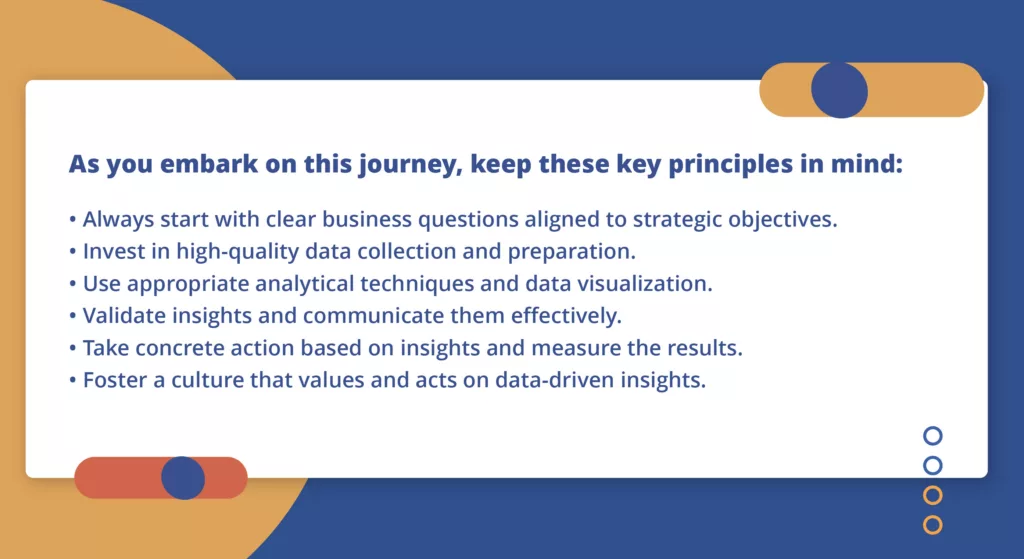
The ability to generate and act on actionable insights is a critical differentiator. By following these seven steps – from defining clear objectives to fostering a data-driven culture – you can transform your organization’s approach to data analysis and decision-making.
Remember, the journey to truly actionable insights is ongoing. It requires continuous refinement, learning, and adaptation. But with persistence and a systematic approach, you can unlock the full potential of your data to drive meaningful business impact.