

Making the Case for Continuous Improvement
Blog posts that pontificate that X is better than Y get people’s attention, but it is rarely the case that when you juxtapose two totally legitimate business priorities that one is completely ‘right’ and the other is completely ‘wrong’. So, allow me to set the table for why we encourage our clients to focus on serial analysis coupled with a continuous improvement mindset rather than pursuing large disruptive wins.
First and foremost, this is not an either/or decision unless you make it one. Most companies we work with have resource limitations or constraints of one kind or another:
- Developer bandwidth with an already-competing list of priorities
- Budgeting & approval processes
- Missing skills/roles/expertise to execute specific impactful deliverables
- Lack of executive sponsorship
- Lack of organizational will
From a practical standpoint, organizations often end up in either/or scenarios where all of the factors above contribute to situations where you have “all hands on deck” supporting one big initiative for some period of time: large go to market push, web or app launch or rebuild, major digital transformation initiatives. Yes, business as usual tasks still need to happen, and the day to day operations continue to be supported, but it is possible for readily available opportunities for improvement to get lost in the shuffle in the pursuit of a grand vision.
A Continuous Improvement Mindset Will Serve You Well
Continuous improvement, as a matter of principle, starts from a foundational principle that there are always opportunities to make something better: user experience, operations, customer service, sales processes, order fulfillment, customer engagement. Our work largely focuses on our client’s digital capabilities, so most of the examples that follow come from those areas of the business.
In terms of operationalizing this mindset, a few key pillars need to be in place:
- The ability to formulate actionable business questions
- Utilizing quality data through serial analysis to answer business questions and hypotheses aligned directly to actionable outcomes
- Organizational will and commitment to prioritize and execute on improvement opportunities that reveal themselves through this process
If you build a continuous improvement mindset into your ways of working across a company, this is one of the best investments you can make in your company and your people. I’m not suggesting that you run out and get everyone in your company Six Sigma certified, but if you can instill a set of principles and processes into every team that prioritizes using data and ongoing analysis to identify and prioritize improvements, this is the key.
Why Continuous Improvement Trumps the Pursuit of Big Wins
A handful of attributes set data and analysis driven continuous improvement apart from pursuing big, disruptive wins for your business.
Time to value is one big factor: when you prioritize identifying and executing improvements as an ongoing discipline, you make modest incremental enhancements on a regular cadence. While each of these changes contributes a small amount of improved performance, the velocity and frequency of these incremental improvements adds up to meaningful improvements over the course of a quarter or a year:
- Identify errors, bugs, friction & drop-off points, and broken user experiences sooner
- Identify and prioritize key engagement points, content, products, and digital assets for focused improvements
- Support a robust testing program with data-informed hypotheses and priorities
- Utilize digital insights to inform omnichannel experience: retail merchandising, for example
The value of this approach is limited only by your creativity and ingenuity in formulating actionable business questions and committing to digging into the data and peeling back the layers of the onion until you generate the insights you need to confidently take action.
PRO TIP: Not to state the obvious, but just a reminder that the proliferation of AI-based productivity and analysis tools can help immensely with serial analysis efforts, especially where large data sets and statistics based approaches are concerned (always with the guardrail of human nuance and genuine human intelligence at the helm). Always sanity check outputs against your known business data and domain expertise, and double check that the insights you generate are backed by sound data and analysis (the way you would your manually generated outputs).
Big, disruptive business change often occurs on much slower time scales or with much more massive overhauls to technology, data infrastructure, and processes. Yes, you can also fully vet, plan, and test these larger scale initiatives, as you should.
But realizing the gains from these investments is often slower to come to fruition than planned and with less dazzling results than expected.
Focusing on immediate opportunities, whether it is catching bugs and poor user experiences more quickly and addressing them, or proactively singling out key content and areas of the website where your users spend their time and attention for improved user experience, the continuous improvement operational approach gives you a lot more little wins consistently across the year.
Your specific opportunities for improvement will vary, but consider a twelve month time period and the variety of improvements you can make if you are in continuous improvement mode using rigorous analysis and insights and testing protocols:
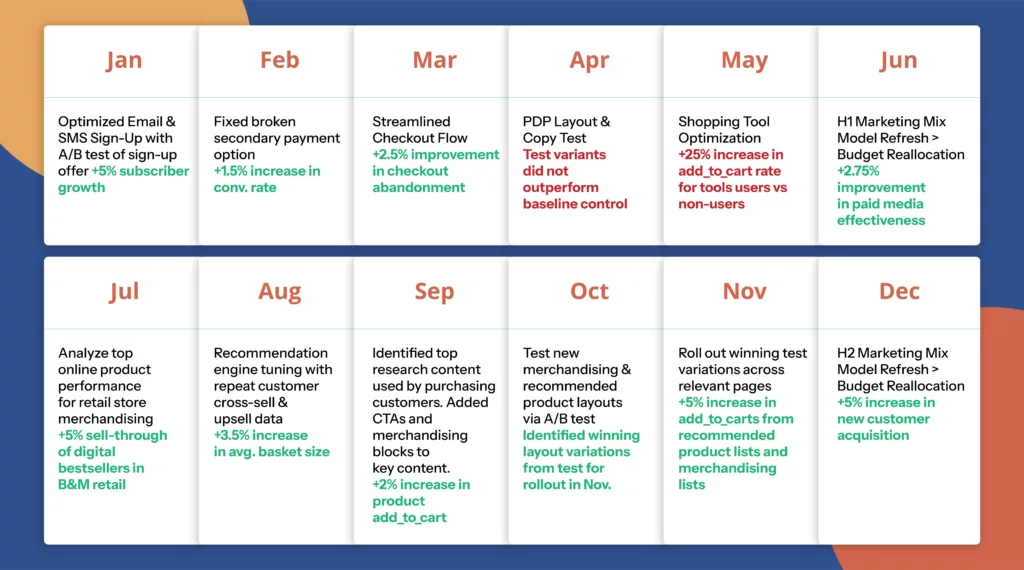
Most of these examples are centered around digital assets and marketing performance, but there is no reason you cannot apply these guidelines across your entire organization.
The reason why consistently achieved, incremental performance gains trump big disruptive wins boils down to four key reasons:
- Wins at this scale are more consistently and predictably achievable
- Incremental improvements are achievable within shorter timeframes
- Over time, the cumulative impact of incremental improvements is substantial
- Encourages companies to prioritize data-backed opportunities to fix issues or improve user/customer experience in meaningful ways: changes can be tested as quickly as possible and winning improvements rolled out widely
With the 2024 World Series just behind us and the L.A. Dodgers once again crowned champions, allow me to wrap up this post with a sports analogy. As a team, when you spend your time at bat focused on the disciplined pursuit of incremental wins (singles and doubles), sometimes you get to experience the best of both worlds. When you hit a home run (big, disruptive wins), the impact is so much sweeter when you have those bases loaded with runners (past incremental improvements).